
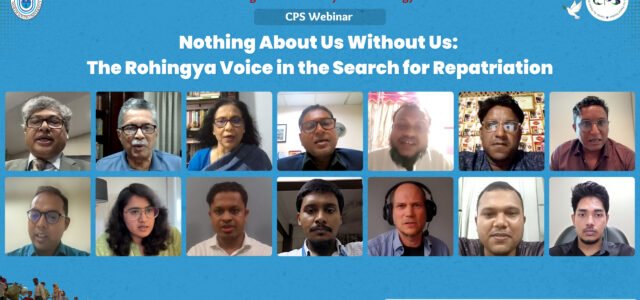
NSU Hosts Webinar on “Nothing About Us Without Us: The Rohingya Voice in the Search for Repatriation”. North South University’s (NSU) Center for Peace Studies (CPS) convened an international webinar on 25th August to commemorate the 9th anniversary of the Rohingya genocide with scholars, diplomats, and leading figures from various countries. The event was titled “Nothing About Us Without Us: The Rohingya Voice in the Search for Repatriation,” marking the date of August 25, 2017, when hundreds of thousands of Rohingya refugees were fleeing from Rakhine State to the Bangladesh border.
Professor Dr. M Jashim Uddin, Director of CPS, in his opening remarks mentioned that no durable solution for the Rohingya situation was possible without meaningful involvement from Rohingya and suggested five principles for any prospective repatriation process: i) accept Rohingya voice, ii) ensure safety and security conditions, iii) ensure voluntary repatriation by choice, iv) create credible verification mechanisms, and v)involve international monitoring. He also stressed that the world should pay more attention to Bangladesh and ensure its hosting of over 1.3 million refugees and sustained track one and two diplomacy, including informal dialogue with the Arakan Army, which runs about 90 percent of the state of Rakhine. Professor Jashim criticized the Rohingya repatriation agreement signed in November 2017, stating that its clauses failed to protect the self-identity, citizenship, and other human rights of the Rohingya people.
Three panelists from the Rohingya community addressed pressing issues. Rohingya activist and human rights advocate Mohammed Tofail said that a generation born in exile is growing up, and humanitarian aid is crucial but not a true replacement for a safe and dignified repatriation. For his part, Sayed Ullah, first member of the President Panel of the United Council of Rohingya (UCR), has criticized the memorandum of understanding (MoU) between Bangladesh and Myanmar of 2018 by saying that the documents were not drafted involving the consultation with Rohingya communities and that the existing commitments doing the verification process under the MoU’s mandate with the Myanmar authorities and resettling in the so-called model villages would not solve but would instead perpetuate the confinement. Also from the UCR President Panel, Khin Maung pinpointed the crisis as being in decades of persecution since 1942, saying that any framework negotiated without genuine involvement of the Rohingya would ultimately remain incomplete.
Journalist and researcher Adil Sakhawat, who has been covering the crisis since 2017 and has been working with Human Rights Watch, told NRD that the authorities in Rakhine continue to deny the Rohingya community an identity and referred to the killings in Buthidaung in 2024 as a sign that the situation on the ground is not conducive to a return.
Ambassador Humayun Kabir suggested documenting Rohingya history and memory and ensuring that scattered organizations of the Rohingya community create a collective message to represent them. He also noted that the growing influence of Bangladesh in multilateral diplomacy could be utilized to come up with sustainable solutions. Further, Professor Amena Mohsin identified the crisis at its roots in Myanmar state policy and spoke about the displaced women’s testimony of their lifelong affinity towards the homeland and their need for addressing the needs of a digital generation of Rohingya youth.
Again, CPS Director Professor Dr. M Jashim Uddin highlighted why Rohingya repatriation initiatives failed and mentioned the killing of Rohingya Leader Mohib Ullah as a warning against not taking the Rohingya community into confidence in the repatriation process. He also raised doubts over whether the elected Rohingya bodies in existence could represent the scattered Rohingya diaspora throughout the world, and also stated that no just Rohingya repatriation would be possible without an authentic Rohingya representation at the negotiating table.
Dr. Anas Ansar, assistant professor at the NSU Department of Political Science & Sociology and a member of CPS, moderated the session. He noted that the displacement is a protracted one that requires continued international engagement.
In his closing remarks, the Vice Chancellor of NSU, Professor Abdul Hannan Chowdhury, reconfirmed the university’s institutional commitment to elevating Rohingya voices in international political discourse and committed the university to support, socially and academically, the youth and education-related community building among the Rohingya.