
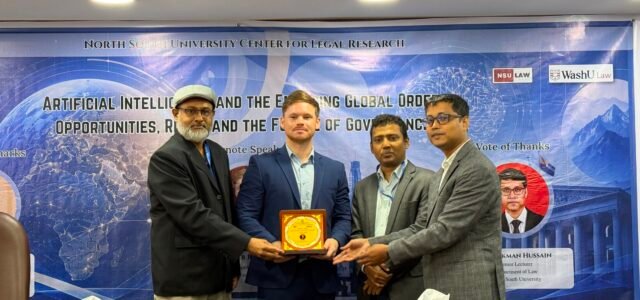
NSU Hosts Talk on AI, Global Order and Future Governance. North South University Center for Legal Research (NSU CLR), in collaboration with the Department of Law, hosted a talk titled “Artificial Intelligence and the Emerging Global Order: Opportunities, Risks, and the Future of Governance” on 17 August 2026. The session brought together faculty members, researchers, and students to examine the opportunities, risks, and governance challenges presented by artificial intelligence in today’s global landscape.
The program started with opening remarks from Professor Ishtiaque Ahmed, Chair of the Department of Law, who welcomed the attendees and reflected on the far-reaching impact of artificial intelligence on legal research and practice. He observed that while legal scholarship and the work of practitioners — including opinion writing and drafting — have traditionally followed standard approaches, AI stands to significantly influence both future legal practice and academic research. He expressed hope for continued collaboration that would benefit not only the NSU community but the wider country, before inviting the keynote speaker to address the gathering.
In his keynote address, Professor Oliver Roberts, Co-Director of the WashU Law AI Collaborative and Adjunct Professor of Law at Washington University School of Law, drawing on his dual perspective as an academic and a practicing attorney in the United States, examined how artificial intelligence is fundamentally reshaping legal policy as well as the day-to-day practice of law, noting a growing — and at times problematic — reliance on AI tools among lawyers. He structured his address around themes including the global landscape of AI adoption, with a particular focus on Bangladesh, the practical use of AI in legal practice, and the ethical considerations and risks associated with the technology.
Presenting comparative data on global AI adoption, Professor Roberts placed special emphasis on the ethical use of artificial intelligence and the necessity of identifying its limitations. He noted that for lawyers, using free AI-based platforms can pose a risk to client confidentiality. He further mentioned that currently, a significant number of lawyers in the United States use artificial intelligence in their professional work, indicating the growing impact of this technology.
He also addressed the misuse of AI in judicial proceedings, the generation of misleading information, and errors resulting from so-called “hallucinations.” Furthermore, by demonstrating various images and videos, he highlighted the challenges AI poses in distinguishing between real and artificially generated content and discussed the harms of the application of AI through multiple judicial precedents. He concluded with a call for future legal professionals to actively shape AI governance and ultimately, balancing AI’s efficiency with rigorous human oversight remains essential to protect client privacy, prevent hallucinations, and preserve judicial integrity.
The keynote address was followed by an open discussion and question-and-answer session, during which attendees engaged directly with the speaker on the themes raised. The program then proceeded to a vote of thanks delivered by Md. Lokman Hussain, Senior Lecturer at the Department of Law, who emphasized the importance of building a strong foundation of knowledge before utilizing artificial intelligence to fully realize its benefits.
The seminar concluded with a memorable crest-presenting ceremony, honoring the keynote speaker as a token of appreciation and respect for his invaluable contributions.
Through this talk, the North South University Center for Legal Research reaffirmed its continuing commitment to fostering scholarly engagement with emerging questions of law and technology, and to strengthening academic collaboration on artificial intelligence and governance between Bangladesh and international partners such as Washington University School of Law.