
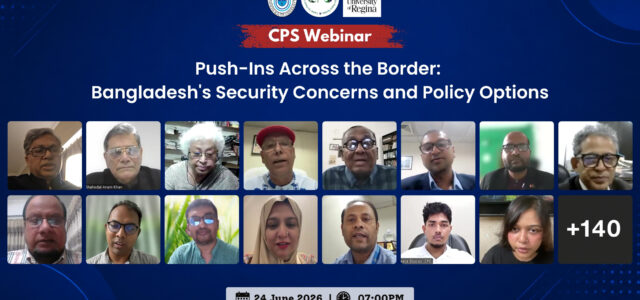
NSU’s CPS hosts Webinar on “Push-Ins Across the Border: Bangladesh’s Security Concerns and Policy Options”. North South University’s (NSU) Center for Peace Studies (CPS), in collaboration with the University of Regina, Canada, organized a webinar titled “Push-Ins Across the Border: Bangladesh’s Security Concerns and Policy Options” on 24 June 2026. The discussion brought together academics, security analysts, journalists, faculty members, and students to examine the issue from security, diplomatic, political, and humanitarian points of view.
Professor Dr. M Jashim Uddin, Director, Center for Peace Studies (CPS), and moderator of the session, in his introductory speech, described push-ins and border killings as long-running threats to Bangladesh’s sovereignty, national stability, and the safety of people living near the border. He stated that, since independence, thousands of people have been illegally pushed into the territory of Bangladesh. He said Bangladesh must resolve its disputes with India, including push-ins, border killings, and water issues, through mutual respect and in accordance with national interest. He emphasized that there is no alternative to deterrence for Bangladesh’s national security. Professor Jashim further stated that, at a time when Prime Minister Tarique Zia is completing successful state visits to Malaysia and China as part of an independent foreign policy, tensions are being observed along the Indian border, including widespread attempts to push Indian Muslims into Bangladesh, border killings, and the mistreatment of Bengali-speaking Muslims.
Dr. Muhammad Asadullah, Associate Professor of Criminology at the University of Regina, focused on anti-Bangladeshi sentiment and the dehumanization of marginalized border populations. Recalling a visit to India in 2024, he said his hosts had advised him not to disclose that he was Bangladeshi because of concerns for his safety. He argued that political rhetoric and social media can deepen hostility, while poor and marginalized people become victims of state politics. He also maintained that India’s federal government cannot shift responsibility entirely to its border states, though he remained hopeful that mutual respect, compassion, diplomacy, and negotiation could produce a solution.
Professor Shahiduzzaman, former Professor of International Relations at the University of Dhaka, viewed India as a major factor in Bangladesh’s existential security. Referring to the idea of Akhand Bharat and writings and maps produced by some Indian strategists and retired military officers, he warned against ignoring possible threats to Bangladesh’s territory. He strongly called for modernizing the armed forces and building stronger defence capacity, arguing that Bangladesh would be able to negotiate more effectively with India and Myanmar only when its diplomacy was supported by military strength. He also called for stronger military and strategic ties among Bangladesh, China, and Pakistan.
Professor Dilara Choudhury, former Professor of Government and Politics at Jahangirnagar University, characterized Indian policy toward its neighbours as hegemonic and argued that unilateral push-ins infringe upon Bangladesh’s sovereignty. She said Bangladesh should accept anyone conclusively identified as a Bangladeshi citizen, but India must first provide proper documentation and follow the agreed repatriation procedure. Warning that large-scale push-ins could destabilize Bangladesh, she called for a united national position and direct diplomatic dialogue with New Delhi, stating that Indian Muslims must not be labelled Bangladeshi and pushed across the border without evidence.
Brigadier General Shahedul Anam Khan, MDS, ndc, psc (Retd.), Executive Editor of The Deltagram, rejected the suggestion that the Bangladesh Armed Forces lacked combat experience or deterrent capacity, recalling their role in the Liberation War and the Chittagong Hill Tracts. He argued that claims of 20 million illegal Bangladeshis in India had been repeatedly used in Indian politics without any verified list. Calling for reinforced borders, stronger surveillance, robust diplomacy, and internal resilience, he said Bangladesh should also consider its trade, market access, transit, and connectivity facilities as strategic assets in negotiations with India.
Abdul Hai Sikder, Editor of The Daily Jugantor, argued that Bangladesh has survived whenever it resisted domination and defended its independence with courage. Referring to the attacks carried out by the Kaderia Bahini along the border after 1975, he recalled how Maulana Bhashani encouraged border communities to stand firm, while Ziaur Rahman formed and trained Village Defence Party units to support security forces and protect local areas. He called for rebuilding such community readiness, fencing Bangladesh’s border, improving defence and technology, taking border violations to the United Nations and international human rights bodies, reforming diplomatic missions, reviving SAARC, and strengthening the country’s media response. He also encouraged regular talks with Indian intellectuals, human rights activists, and citizens who oppose such policies.
Professor Dr. Abdul Hannan Chowdhury, Vice-Chancellor of North South University and chair of the session, described the push-in issue as both a humanitarian and sovereignty concern. He acknowledged serious shortcomings in Bangladesh’s diplomacy, surveillance, intelligence, and border preparedness, and said the country must demonstrate that it is not weak while seeking a congenial relationship with India. He urged CPS to prepare policy recommendations for the government, the Ministry of Foreign Affairs, and relevant institutions, emphasizing that policy-driven action was urgently required.
During the question-and-answer session, faculty members and students raised concerns about the lack of national agreement, weak coordination among state institutions, and the need for a clear process to verify nationality before accepting anyone as Bangladeshi. The panelists called for stronger border security, better documentation and surveillance, firm diplomatic action, and clearer presentation of Bangladesh’s position at home and abroad.
Professor Dr. Nasar U. Ahmed, Pro Vice-Chancellor of North South University, delivered the vote of thanks. He appreciated the historical and policy-oriented contributions of the speakers and stressed the need to build greater public awareness and preparedness.
Also in attendance were Dr. AKM Waresul Karim, Dean of the School of Business and Economics at NSU, and CPS members, including Assistant Professor Dr. Anas Ansar, Senior Lecturer Ms. Parisa Shakur, Associate Professor Dr. Riasat Khan, Professor Dr. Ishtiaque Ahmed and Associate Professor Dr. Ziaul Haq Adnan. Other respected faculty members, invited guests from outside the university, participants from different academic and professional backgrounds, and a large number of students joined the webinar.
The webinar concluded with calls to ensure lawful repatriation procedures, strengthen border security, build national consensus, adopt deterrence as a national security strategy, pursue firm diplomacy, take stronger action in international forums, and protect marginalized communities affected by cross-border politics.