
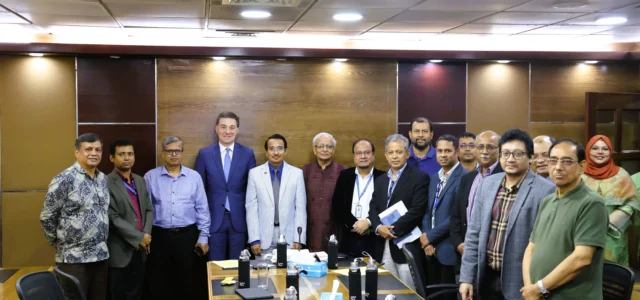
NSU Hosts Seminar on Political Finance and Democratic Accountability in Bangladesh. The Department of History & Philosophy (DHP) and the Department of Political Science & Sociology (PSS) at North South University (NSU) jointly organized a seminar titled “Money in Politics: Party Financing and Accountability in Bangladesh” on Wednesday, 17 June 2026, at 3:00 PM in the SHSS Dean Conference Room (NAC 1024).
The seminar featured Dr. Fernando Casal Bértoa, Associate Professor in the Faculty of Social Sciences at the University of Nottingham, as the keynote speaker. Dr. Badiul Alam Majumdar, Secretary at Citizens for Good Governance (Shujan), attended as Chief Guest. The program was graced by the presence of the Pro-Vice Chancellor of North South University, Dr, Naser U. Ahmed. Dr. Md. Rizwanul Islam, Professor and Dean of the School of Humanities and Social Sciences, delivered the welcoming address. The session was moderated by Dr. Mahbubur Rahman, Professor and Chair of the Department of History & Philosophy, and concluded with a vote of thanks by Dr. Rizwan Khair, Associate Professor and Chair of the Department of Political Science & Sociology.
Opening the seminar, Dr. Mahbubur Rahman underscored the urgency of the subject, noting that financial influence over politics carries serious risks for governance and public integrity. “Money influences politics and it can do so in deeply negative ways,” he observed. “Even sitting members of parliament carry debt obligations running into thousands of crore taka. The question of how elected officials maintain distance from conflicts of interest is one Bangladesh must answer honestly.” He noted that expenditure in local union parishad elections alone routinely runs into millions, illustrating how financial pressures permeate every tier of the political system.
Dr. Rizwanul Islam welcomed the distinguished panel, noting that the convergence of international expertise and seasoned domestic advocacy made for an exceptionally qualified discussion. “Our chief guest has worked in this area for a long time,” he said. “It would be difficult to assemble a more informed panel on this subject.”
Dr. Fernando Casal Bértoa, a member of the core group of political party chairs within the Organisation for Security and Co-operation in Europe (OSCE) and co-author of a forthcoming volume with Oxford University Press on political party regulation, delivered a comprehensive analysis of Bangladesh’s political finance challenges.
He identified three interconnected problems undermining democratic stability: widespread corruption, weak party institutionalisation, and disproportionately low female representation in parliament. Citing Transparency International’s global rankings, he noted that Bangladesh currently stands at 151st position among countries surveyed for perceived public sector corruption among the lowest-ranked nations globally.
Dr. Casal Bértoa argued that strong political parties are essential to sustaining democratic institutions, and that Bangladesh’s party structures remain insufficiently developed to resist patronage and financial manipulation. He also highlighted that woman comprise only 3.5 percent of directly elected members of parliament a figure significantly below regional and global averages and drew on comparative research suggesting that greater female parliamentary representation correlates with reduced levels of political corruption and political polarization.
On the question of financing reform, Dr. Casal Bértoa outlined three models of public political funding, cautioning that the transfer of public funds to parties without stringent regulatory controls could worsen existing problems rather than resolve them. He called for the prohibition of corporate donations to political parties in Bangladesh, an update to outdated campaign spending limits, the introduction of donation caps, and robust transparency requirements covering party accounts and electoral expenditure. “Without public funding, controlling political corruption is extremely difficult but public money without proper oversight may make things worse,” he stated.
Dr. Badiul Alam Majumdar offered a candid and historically grounded perspective on the erosion of political integrity in Bangladesh. Reflecting on asset declarations submitted by candidates across successive election cycles, he noted a striking pattern: officeholders across party lines have seen their personal wealth increase substantially during periods in power. “Money influences the power a person holds,” he said. “Politics in our country is no longer a public service it has become a profitable business.”
Dr. Majumdar expressed frustration that audit reports and expenditure declarations remain shielded from public scrutiny. He called for mandatory submission and public disclosure of campaign accounts. Referencing the broad public sentiment reflected in the informal use of the word “politics” as a synonym for deception in everyday Bangladeshi conversation, he lamented the collapse of the original ideal of politics as civic duty. He also raised concerns about student political wings being used as instruments of organized violence and called for the development of parties around clear ideological commitments rather than family-based or personality-driven structures.
Speaking in his closing remarks, a senior university official agreed with the keynote speaker’s argument for public funding as a starting point for systemic reform. He emphasized that institutional ethics and civic education must be cultivated from an early stage, and that the university bears responsibility for helping build moral foundations within public life.
The seminar reflected NSU’s ongoing commitment to hosting rigorous academic discourse on matters of national consequence. The School of Humanities and Social Sciences continues to facilitate platforms where scholars, policymakers, and civil society practitioners engage in evidence-based analysis of the challenges facing Bangladesh’s democratic institutions.