
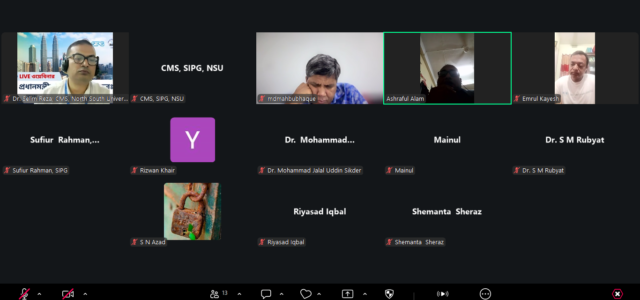
NSU Held Webinar on Prime Minister’s Malaysia Visit and Prospects of Reopening the Labour Market. North South University’s (NSU) Center for Migration Studies (CMS) of the South Asian Institute of Policy and Governance (SIPG) held a live webinar titled “Prime Minister’s Malaysia Visit: Will the Closed Labour Market Reopen?” on 22 June 2026 (Monday). The webinar was organized in the context of Prime Minister Tarique Rahman’s official visit to Malaysia and the renewed discussion on reopening the Malaysian labour market for Bangladeshi workers. The session was moderated by Dr. Selim Reza, Associate Professor and Coordinator of CMS, North South University.
A Bangladeshi migrant worker based in Malaysia, Ashraful Alam shared field-level experiences of Bangladeshi workers, particularly those living with irregular status and those detained or serving sentences in prison. He highlighted challenges related to documentation, work permit renewal, high migration and recruitment costs, complications surrounding calling visas, employer dependency, and limited access to reliable information and legal support. He disappointedly pointed out the poor-quality services at the Bangladeshi High Commission in Kuala Lumpur.
Dr. Md. Mahbubul Haque, Senior Lecturer at the Universiti Sultan Zainal Abidin (UniSZA),, Malaysia, noted that there had been no official confirmation of any MoU specifically related to reopening the Malaysian labour market. Referring to a previous official visit by Bangladesh’s interim government, he said labour migration had also been discussed then, but no major progress followed. He expressed hope that the current visit would create a practical way forward for undocumented Bangladeshi workers and those detained in Malaysia. He also emphasised that Rohingyas in Malaysia should get proper policy attention.
Dr. Mohammad Jalal Uddin Sikder, Associate Professor and member of CMS, North South University, observed that Bangladesh and Malaysia already have a significant number of MoUs and bilateral cooperation frameworks. He emphasized that the discussion should not remain confined to labour migration, but should also explore new areas of economic cooperation. He particularly highlighted the halal industry as a promising sector for investment, trade, certification, food processing, and service-sector collaboration.
Emrul Kayes, Special Correspondent, BanglaVision TV, emphasised that the government should pay closer attention to the conditions of Bangladeshi workers already living and working in Malaysia. He said future discussions should address not only the sending of new workers, but also the rights, safety, documentation, welfare, and current challenges of existing workers. He also stressed the need for transparent recruitment so that workers can migrate through a fair, accountable, and cost-effective system so that evil syndicates can not dominate the process.
S N Azad, Senior Lecturer and Member of CMS, observed that the Prime Minister’s meeting with workers had created hope among Bangladeshi migrants in Malaysia. However, he cautioned that the visit alone may not resolve the longstanding labour market crisis unless followed by concrete policy action. He pointed to weak preparation, excessive discretionary control, inadequate data, and lack of institutional transparency as major challenges in Bangladesh’s labour migration governance. He emphasised the need for collaboration among civil society organisations in Malaysia and Bangladesh to protect the rights of migrant workers.
Ambassador Sufiur Rahman, Senior Research Fellow at SIPG, North South University, observed that the Prime Minister’s visit to Malaysia should not be viewed solely through the lens of labour migration. He noted that the visit also covered broader priorities, including trade, investment, the proposed free trade agreement, regional cooperation, and overall bilateral engagement. At the same time, he emphasized that Malaysia’s economy is changing, and Bangladesh must prepare workers with the high-end skills required by Malaysia’s evolving labour market.
The webinar was attended by academics, migration researchers, journalists, students, and members of the public. It concluded with a call for evidence-based policymaking, sustained diplomatic engagement, transparent recruitment, and stronger protection for Bangladeshi migrant workers in Malaysia.