
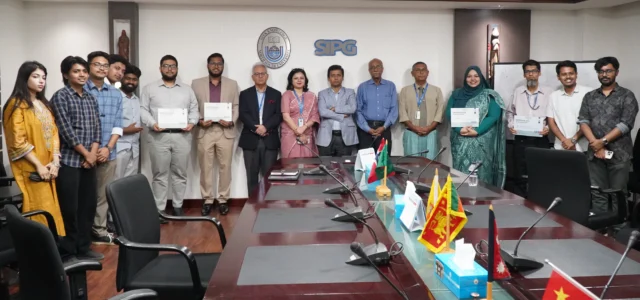
NSU hosted SHSS Graduate Colloquium for Spring 2026. North South University’s (NSU) School of Humanities and Social Science hosted the SHSS Graduate Colloquium for the Spring 2026 semester on 04 April 2026 (Saturday), drawing participation from faculty members, students, and researchers in an engaging academic setting.
The event featured presentations of research papers by the graduate students from different departments. The presenters included Asif Mahmud Bin Tariq from the Department of History and Philosophy, Abdullah Naquib from the Department of Law, Rifa Sanjida from the Department of English and Modern Languages, and Md. Parvez Hasan Yousuf from the Executive Master’s in Policy and Governance (EMPG), South Asian Institute of Policy and Governance (SIPG). The session was moderated by Ms. Samila Nowshin, Lecturer at North South University, who guided the proceedings and facilitated the discussion.
Mr. Asif Mahmud Bin Tariq presented his paper titled “The Silk Road: Past, Present, and the Future.” Mr. Abdullah Naquib presented a paper titled “Addressing the Challenge of Financial Crime in the Digital Age.” The title of Ms. Rifa Sanjida’s paper was “Exploring ChatGPT as a Pedagogical Tool for Pronunciation Development in the Tertiary-Level EFL Academic Speaking in Bangladesh.” And lastly, the topic of Mr. Md. Parvez Hasan Yousuf’s paper was “The Political Economy of the July 2024 Mass Uprising in Bangladesh: A Disciplined-Configurative and Heuristic Case Study.”
In his welcome remarks, Professor Md. Rizwanul Islam, Dean of the School of Humanities and Social Science at North South University, thanked graduate students for choosing thought-provoking themes. He also urged colleagues to continue the proud tradition of NSU SHSS of providing platforms for students to showcase their research prowess.
The presentations were followed by an interactive Q&A session, where faculty members and participants engaged with the presenters, offering reflections and raising thoughtful questions. In his concluding remarks, Professor Halimur Rashid Khan reviewed all four research papers, highlighting their strengths and offering constructive feedback where necessary. He also suggested various approaches and methodologies that could enhance the quality of the papers and support their potential for future publication. The session concluded with appreciation for the presenters and their contributions, reflecting the School’s continued commitment to fostering a vibrant research culture.