
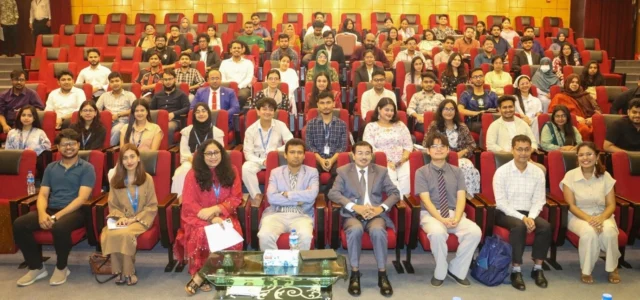
NSU Hosts Public Talk on Institutionalizing Peace for Sustainable Development. A public talk titled “Institutionalizing Peace for Sustainable Development: Advancing the DPCW-Based Peace Governance through Local Corporations” was held on 13 June at Audi 801 of North South University. The event was organized by the Center for Legal Research of Department of Law, North South University, in collaboration with the South Korea-based international NGO Heavenly Culture, World Peace, Restoration of Light (HWPL), the NSU Law and Mooting Society, and the Bangladesh Forum for Legal and Humanitarian Affairs (BFLHA).
As part of their ongoing partnership, BFLHA and HWPL jointly convened the seminar to address pressing challenges relating to the rule of law, human rights protection, and community-based peacebuilding in Bangladesh. The initiative sought to establish a platform for peace governance by bringing together legal scholars, human rights practitioners, policymakers, students, and youth leaders to exchange perspectives on advancing sustainable peace through local cooperation and institutional engagement.
The session was chaired by Professor Nasar U. Ahmed, Pro Vice Chancellor of North South University. In his remarks, he emphasized the importance of diversity in building peaceful societies. He noted that people belong to different groups, cultures, and religions and highlighted how Kazi Nazrul Islam’s writings are connected to the principles of the United Nations Charter. He further stated that North South University contributes to shaping society through knowledge creation and by addressing national and international challenges that threaten peace.
Among the distinguished panelists was Professor Rizwanul Islam, Professor of Law and Dean of the School of Humanities and Social Sciences at North South University. He observed that achieving peace in a country like Bangladesh can be challenging and stressed that peace cannot be reduced to the mere absence of violence. He noted that while Western powers often advocate for human rights and peace, these principles are sometimes applied subjectively. Referring to ongoing conflicts and humanitarian crises, he stated that international humanitarian law has been significantly challenged in regions such as Gaza and Iran.
The introductory speech was delivered by Benjamin Kim, Coordinator of the Department of Peace Education at HWPL. He highlighted the organization’s continued efforts to promote peace through education, dialogue, and international cooperation. Jacob Bae, Coordinator of the International Peace Youth Group (IPYG), was also present at the event.
The opening remarks were delivered by Lokman Hossain, Coordinator of the Center for Legal Research. The event was moderated by Sayere Nazabi Sayem, President of the Bangladesh Forum for Legal and Humanitarian Affairs. The session was coordinated by the senior lecturer of department of law Nasmin Jabin Noor.
As part of the program, all participants signed a declaration titled “Signatory in Support of the Declaration of Peace and Cessation of War,” expressing their commitment to the promotion of peace and peaceful conflict resolution.
The event concluded with the presentation of tokens of appreciation to the guests in recognition of their participation and contributions. Through insightful discussions on peace governance, human rights, and sustainable development, the program reinforced the importance of collaborative engagement among academic institutions, civil society organizations, and international partners in advancing a more peaceful and resilient society.