
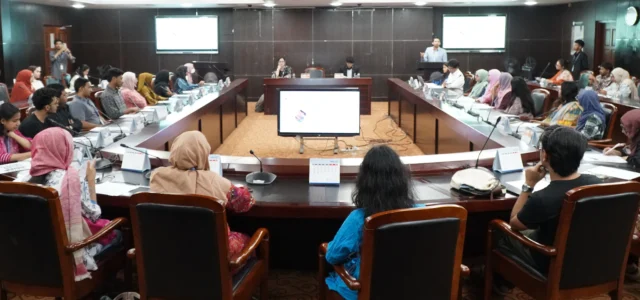
NSU Organized Workshop on Digital Wellbeing and Managing Screen Addiction. North South University’s (NSU) Counseling and Wellbeing Center (CWC), with the support of the Public Health and Sciences Club (PHSC), organized a workshop titled “Digital Wellbeing & Managing Screen Addiction” for the students on 09 April 2026 at Syndicate Hall, NSU.
Dr. Azaz Bin Sharif, Associate Professor and Chair of the Department of Public Health, in his opening remarks, emphasized that while digital screens are now an unavoidable part of life, mindful usage is essential. Reflecting on everyday realities, he questioned whether we should expose children to screens without boundaries and highlighted how even older generations are increasingly engaged in unproductive scrolling, often prioritizing content consumption over meaningful engagement.
Dr. Sumaiya Khaled, Lecturer, Department of Public Health and Faculty Advisor of PHSC, spending more than four hours daily on screens can be indicative of problematic use and highlights how it leads to distraction in academic settings. She also addressed mental health concerns such as loneliness, peer pressure, and the need for validation through likes and reactions, along with physical risks like Text Neck. She concluded with a powerful message, “Don’t let your life become something you only watch on a screen.”
Md. Shaphawat Hossain, Assistant Director and Senior Student Counselor at CWC, explained how screen addiction starts with a simple habit and grows towards dependency. It starts to feel better and consequently ends up in compulsion. Young adults fear that if they do not stay online, they will miss out (Fear of missing out-FOMO) on peers. Eventually, they develop nomophobia, where they become anxious without a phone or Wi-Fi. They become emotionally dependent on their devices, expecting comfort and satisfaction from constant connectivity.
The workshop then transitioned into interactive and activity-based sessions conducted by the CWC team. They addressed how social media acts as a validation-seeking tool where individuals become dependent on reactions and external approval, often without realizing the extent of control it has over their behavior. In order to connect with everyone on social media, in reality, we are becoming lonelier and more isolated. They encouraged self-reflection and awareness in online interaction. Consciously choosing real-life engagement over digital distractions can bring balance in life.
The session concluded with remarks by Dr. Abdul Khaleque, Professor, Department of Biochemistry and Molecular Biology (DBM), and Proctor. He emphasized the importance of balancing connection and disconnection, noting that while digital tools are beneficial, excessive use disrupts natural biological processes. He explained how constant gratification and prolonged exposure to blue light from screens cause disruption in sleep and attention. He motivates the students to take a break every 20 minutes to look at a distant object for 20 seconds to reduce eye strain.
The workshop participants appreciated the initiative as it combined real-life experiences, scientific insights, and practical strategies to address a growing concern. It encouraged participants to reflect deeply on their digital habits and take conscious steps toward achieving a healthier and more balanced lifestyle.
Students shared how excessive screen use has affected their academic focus and daily lives. Several admitted they could no longer concentrate on studies as before. One student expressed frustration over constant procrastination, mentioning how days pass without realizing where the time went. Another shared feeling of self-doubt, believing she was no longer a capable student.