
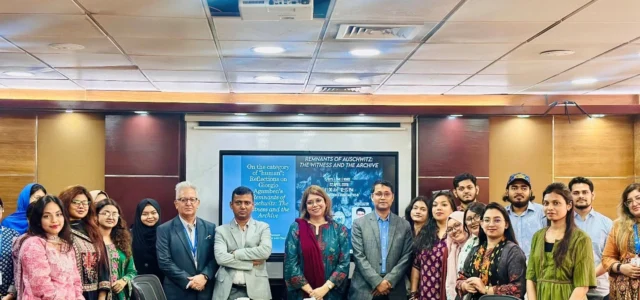
NSU SHSS Study Circle: The Category of Human in Agamben’s Remnants of Auschwitz. North South University’s (NSU) School of Humanities and Social Sciences (SHSS) organized a talk on ‘On the category of “human”: Reflections on Giorgio Agamben’s Remnants of Auschwitz: The Witness and the Archive’ on 22 April, 2026.
The session was held at the NSU SHSS Conference Room, as part of the NSU SHSS Study Circle. The keynote speaker was Dr. Nazia Manzoor, Assistant Professor & Chair, Department of English and Modern Languages at NSU.
NSU SHSS Study Circle talk on ‘On the category of “Human”: Reflections on Giorgio Agamben’s Remnants of Auschwitz: The Witness and the Archive’.
Mr. Md. Lokman Hussain, Senior Lecturer at NSU, moderated the session and pointed out that the youth have much to learn from critically engaging with philosophical and literary texts that interrogate humanity, ethics, and memory. Professor Md. Rizwanul Islam, Dean of the SHSS at NSU, commenced the discussion with the opening remarks, He underscored the enduring relevance of classic literature in exploring classic and critical literature in exploring questions of human identity and moral responsibility.
Dr. Manzoor began by exploring Giorgio Agamben’s conceptualization of the “human” through the ethical role of shame, the figure of the witness, specifically in the context of Holocaust testimonies. She examined the figure of Muzelmann and how Agamben challenges conventional notions of subjectivity and voice by foregrounding those who exist at the threshold of language and silence. Drawing on key arguments from Remnants of Auschwitz, she elaborated on the ethical implications of bearing witness, the paradox of testimony, and the role of the archive in preserving fragmented histories.
During the Q&A session, faculty members and students actively engaged with the guest speaker on themes such as the ethics of representation, the politics of memory, the parallels of Muzelmann, and the relevance of Agamben’s ideas in contemporary global contexts. The collaborative discussion of ideas engaged all the attendees.