
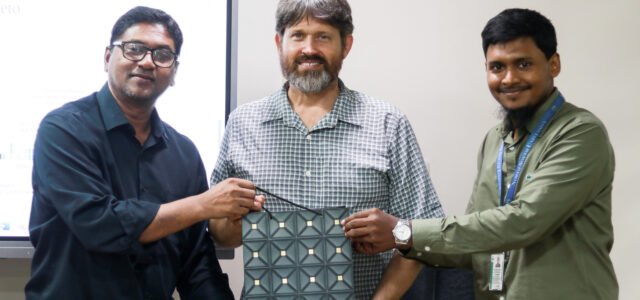
NSU hosts lecture on UN Security Council challenges and reform. North South University’s (NSU) Center for Peace Studies (CPS) organized a lecture series titled “The UN Security Council: Challenges and the Way Forward” on 20 September 2026 at the Law Department Conference Room of North South University. Dr. Virgil Hawkins, Professor at the Osaka School of International and Public Policy (OSIPP), Osaka University, delivered the keynote address.
The session was moderated by CPS Director Professor Dr. M Jashim Uddin. Dr. Ishtiaque Ahmed, Barrister-At-Law, MCIArb, Chair, Department of Law, and Dr. Rizwan Khair, Chair, Department of Political Science and Sociology, participated in the session, which ended with a vote of thanks delivered by Dr. Ziaul Haq Adnan, Chair, Department of Management at North South University.
In his opening speech, Professor Dr. M Jashim Uddin presented the context for the formation of the United Nations and noted that the objective was to bring Peace to the world, but its guardianship in managing and resolving conflict, as well as its role as a collective security player, are in question. He also questioned the role of major powers in misusing their veto power, which is a concern for global peace in the long run.
The keynote speaker, Dr. Virgil Hawkins, provided a thoughtful discussion on the institutional mechanism of the United Nations Security Council (UNSC) and the extent to which it contributes to global peace and security. He discussed how the unelected P5 and elected members of the UNSC are responding to the global security crisis. He sought to showcase the findings of his research experience at the UN through a pattern in which the UNSC P5 most often exercised their veto power when member states had the least support. Notably, figured out that the UNSC is responding to the crisis based on the powerful countries’ priorities, comparing two examples—formulating a UN resolution within 6 days of the terrorist attack in Spain, but taking 6 years to respond to the long-standing conflict in Sierra Leone. Overall, he concluded that the effort to reform the UN must prioritize the small states’ voice, which constitutes the majority of votes in the United Nations General Assembly.
The Director of CPS thanked the keynote speaker for his thoughtful discussion and urged a way to overcome the politicization of the Security Council so that nations do not become victims of the “unlathed” five members of the Security Council. Then he urged Dr. Ziaul Haq Adnan to give the vote of thanks, and the session was concluded accordingly.