
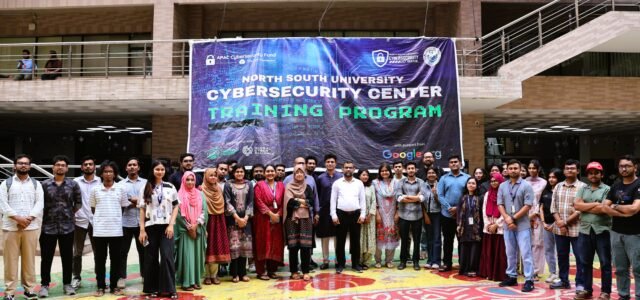
NSU Launches Six-Day Specialized Training to Strengthen Cybersecurity for the MSME Sector. North South University (NSU) Cybersecurity Center successfully commenced Course 2, Cohort 2 — a rigorous six-day professional training program titled Integrated Cybersecurity Framework for MSMEs: Risk Assessment, Incident Response & IT Audit on 30 July 2026 (Thursday). Designed specifically for NSU students, this cohort builds advanced practical skills that will enable participants to support Micro, Small and Medium Enterprises (MSMEs) through the Center’s Cybersecurity Clinic initiative.
The program combines solid theoretical foundations with extensive hands-on practice. Over six days, students progress from understanding how cyberattacks unfold to conducting full risk assessments, performing technical gap analyses, responding to simulated incidents, and producing professional IT audit reports. Participants work in teams using realistic fictional MSME profiles (clinic, logistics firm, café, school, and retail shop). They identify assets and threats, apply the STRIDE threat-modeling method, build and score risk registers, run professional security tools such as Lynis, Microsoft Baseline Analyzer, and OpenVAS/Nessus Essentials on prepared virtual machines, write formal findings using the 5C structure, and map results against ISO 27001 Annex A controls. A full ransomware tabletop exercise following the NIST 800-61 incident response lifecycle allows students to practice detection, containment, communication, and lessons-learned processes. The final days focus on remediation planning, technical validation of fixes, and the production of complete audit reports suitable for real MSME clients.
This intensive, practice-oriented approach ensures every participant leaves with immediately usable competencies in risk assessment, gap analysis, incident response, and IT auditing — exactly the capabilities required to deliver high-quality services to MSMEs. Graduates of the program will contribute directly to the Center’s goal of supporting at least 300 digitally vulnerable organizations through hands-on assessments and advisory support. The initiative is backed by the APAC Cybersecurity Fund (The Asia Foundation, with support from Google.org).
The NSU Cybersecurity Center invites the Public Relations team to feature this program through website news, social media coverage, and photography of classroom and laboratory sessions. Visuals of student teams analyzing systems, presenting risk registers, and engaging in the incident simulation would effectively highlight both the technical depth of the training and NSU’s growing leadership in applied cybersecurity education for national impact.
The Center remains committed to producing job-ready cybersecurity professionals who can deliver measurable value for Bangladesh’s MSME sector.